
Lactate Threshold testing allows for a unique understanding regarding the optimal intensity your body can withstand before becoming unable to keep up. Using a WattBike Atom V2 and a range of other equipment, we are able to record highly accurate data, which can then be used to optimise future training programmes.
Learn more about how we interpret your lactate threshold testing results, to be sure you know exactly what you’ll be getting from this service.
An overview of the lactate threshold testing process
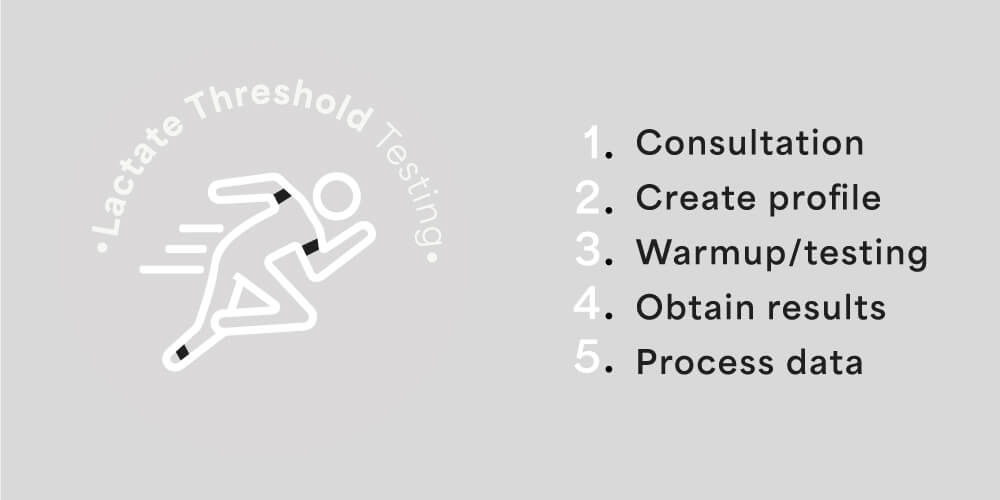
The lactate threshold testing process consists of five main stages:
- 1Consultation - A brief overview of your current fitness and future goals.
- 2Create profile - Taking height, weight and baseline blood lactate sample.
- 3Warmup/testing - 10 minute steady warmup on bike or treadmill, before more intense training which increases in intensity every 3-5 minutes.
- 4Obtain results - Clinician records heart rate, rate of perceived exertion and blood lactate sample through finger prick blood test.
- 5Process data - Data is analysed and used to optimise your training patterns moving forward.
What does a lactate threshold test tell you?
A lactate threshold test reveals the intensity at which your body starts accumulating lactate in the blood faster than it is able to clear it, which is the point of shift from aerobic to anaerobic energy.
When simplified, what this means is that lactate testing reveals the level of intensity at which you can exercise before you start to fatigue more quickly. The switch from aerobic to anaerobic respiration signifies the point when your body is relying on energy ‘without oxygen’, which produces lactate.
How lactate threshold is measured and scored

Lab testing is the best possible method for measuring and scoring your lactate threshold. We’ll use a graded exercise test, during which blood samples are taken at increasing intensities, allowing us to plot the results on a graph to understand when lactate rapidly accumulates.
LT1 refers to the moment at which lactate levels begin to slowly rise above base levels, whilst LT2 is the point at which lactate levels begin to increase exponentially, meaning that the athlete is exercising at an intensity where the accumulation of lactate cannot be cleared by the body.
What is a good lactate threshold score?
A good lactate threshold score will depend on your fitness level.
What the results of a lactate threshold test mean
The results of a lactate threshold indicate exactly where your body can no longer clear the level of lactate building up (the shift to anaerobic respiration).
These results define your optimal training zones, signalling how hard you can push yourself before fatigue starts to rapidly set in. Working to your threshold limits, without bypassing them, allows you to gradually increase your lactate threshold, increasing your endurance over time.
Using your lactate threshold results
Using lactate threshold results means translating them into actionable training zones, with the goal of boosting endurance, optimising intensity, and tracking fitness progress.
Results allow you to focus on training below the lactate threshold for optimal pacing and real-time tracking of energy use. Utilising these results allows professionals (such as the Injury Mechanics team) to advise regarding precise adjustments to your workout to gradually but consistently improve performance.