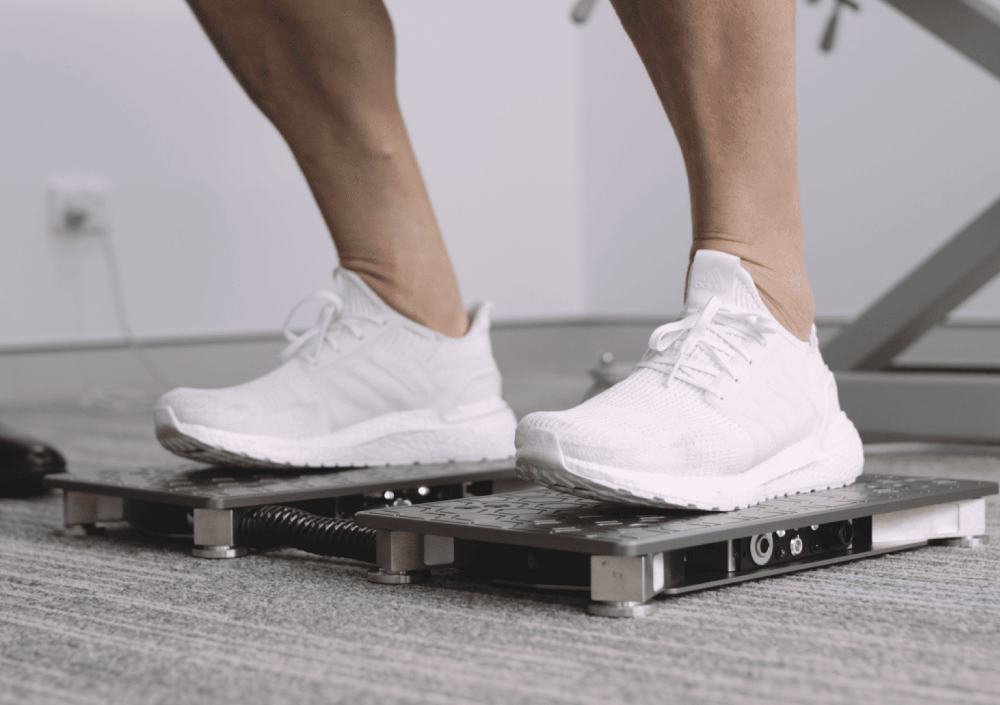
Force plate testing uses highly-specialised technology and sophisticated sensors to provide objective data, for use by professionals.
The results from force testing can be applied to fitness programs and used to help sports performance. They are also useful for injury rehabilitation because they allow physiotherapists to create personalised recovery plans based on discovered strengths and weaknesses.
What is force plate testing?
Force plate testing is a process which uses finely-tuned sensors to measure ‘ground reaction forces’ to provide objective insight into athletic abilities. A range of exercises and tests are usually conducted to get a thorough and holistic overview of your capabilities, strengths and weaknesses.
Which sports use force plate technology?
Sports plate technology is used to improve performance and prevent injury across a variety of sports, including football, rugby and athletics. Its main application is for sports which involve running, jumping and rapid changes in direction which, naturally, is applicable to a lot of sports.
Force plate technology also has useful performance-analysis applications across sports such as volleyball, basketball, cricket and skating, where the tech may be used to analyse bowling/batting techniques, posture, stability and a variety of movement patterns.
On top of this, force plates can be used to prevent injury or aid in injury rehabilitation across all sports.
How force plates help improve athletic performance

Force plates help to improve athletic performance through providing objective data for analysis and ongoing tracking/comparison. They allow experts to measure key metrics, analyse movement patterns and provide real time feedback.
Here is how force plates help optimise technique and movement patterns:
The Injury Mechanics team adopts an evidence-based approach to treatment and rehabilitation. As a result, force plate testing and analysis is perfectly suited to our ethos, so get in touch with us today to get started.
Practical applications of force plate testing results
Force plate testing facilitates evidence-backed rehabilitation or training improvement programs. Using the data collected through force plate testing negates the need for guesswork, and enables experts to create a profile of your capabilities.
Force plate results are also so important for closely monitoring progress during the injury rehabilitation process, which can influence decisions regarding when you may be able to return to sport, and in what capacity.
Specifically, force plates can help to detect imbalances between limbs which might not otherwise be apparent, even for experts. After certain injuries or surgeries, parts of the body learn to compensate for weakened joints, muscles and limbs. Whilst this is necessary for some time, you need to be able to retrain the once injured part of the body to work as it did originally. This is why imbalances must be detected, and amended, through force plate testing.
Injury Mechanics offers force plate testing services, delivered by trained physiotherapists and experts in injury recovery and sports performance. Book your appointment today to get started with your personalised sessions.